
Boycott Birthright
Boycott Birthright
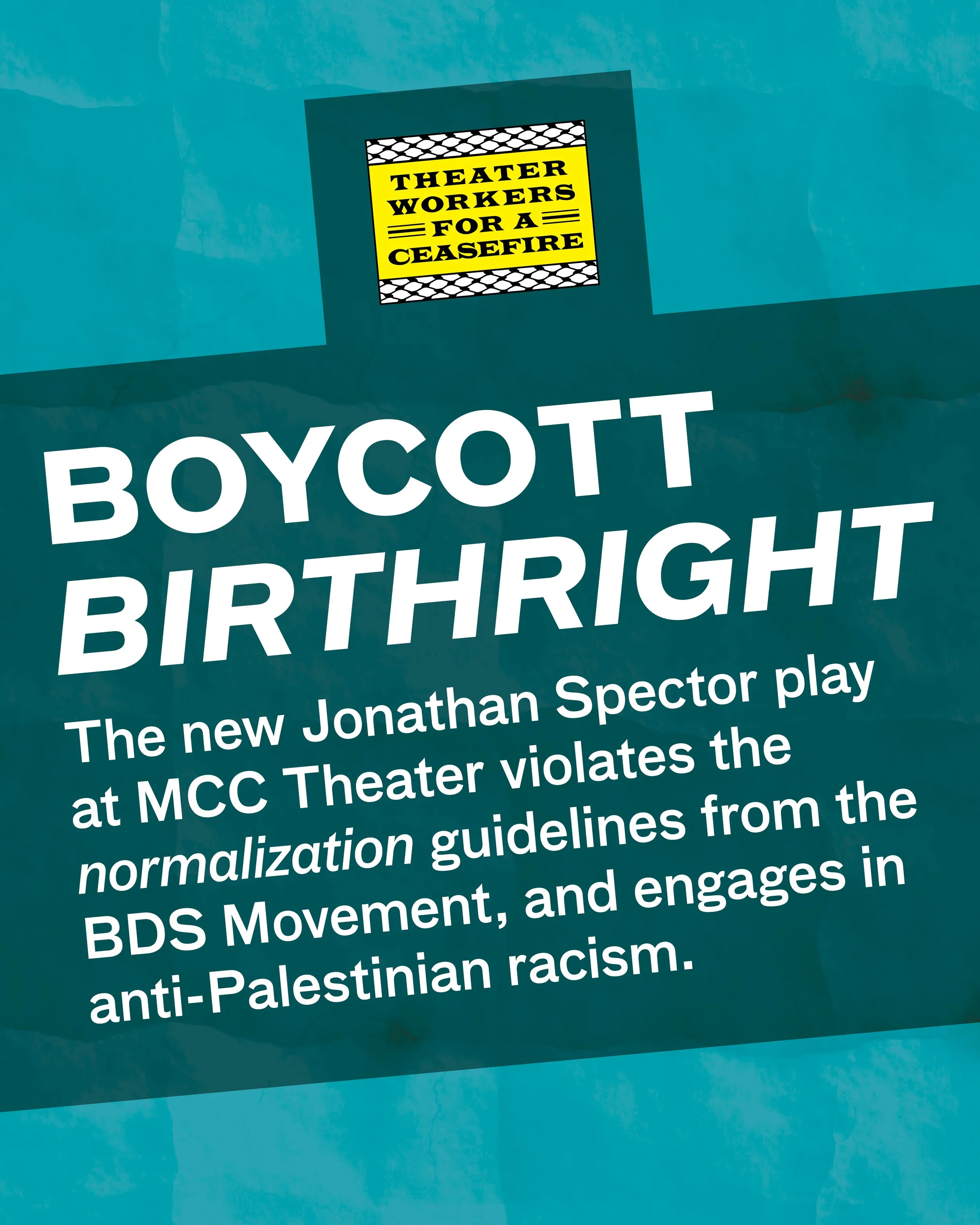
On July 7th 2026, after communication with MCC Theatre reached an impasse, Theater Workers for a Ceasefire called for a boycott of their production of Jonathan Spector’s BIRTHRIGHT due to its violation of the BDS Movement’s normalization guidelines, which outline anti-Palestinian racism and define how cultural products can be complicit to the ongoing genocide and illegal occupation of Palestine.
Our letter has been signed by 226 theater workers and cultural organizations. Read the letter and sign on here.
Understanding normalization and its relationship to harm and complicity may be unfamiliar. This is exactly why it is critical we oppose it.
To provide important background, we have prepared the below FAQ, which addresses the following questions:
What led to the boycott being called?
I thought that the BDS campaign only asks that we boycott cultural products created with support from the Israeli state. From what I understand, Birthright wasn’t made with the support of the Israeli state or its affiliates, so how does calling for a boycott fit with the BDS campaign’s guidelines?
How can a play contribute to Israel’s oppression of Palestine?
How does Birthright normalize the oppression of Palestinians?
Even if this play is objectionable, isn’t calling for a boycott an act of censorship?
Many shows on and off Broadway contain politically objectionable content. Isn’t singling out “Birthright” antisemitic?
There’s been a ceasefire in Gaza for months. Why are you organizing this boycott now?
The play has already opened and many tickets have already been purchased. How will calling for a boycott now change anything?
I understand why we might boycott cultural products explicitly linked to the State of Israel, but isn’t this telling writers what to write?
What led to the boycott being called?
TW4C is calling for a boycott of Birthright because the play violates BDS’s anti-normalization guidelines. The play, as a cultural product, serves to both normalize Israel’s ongoing genocide against the Palestinians in Gaza and perpetuate anti-Palestinian racism. This is not our demand alone, but a demand which comes from the largest coalition of Palestinian civil society, which we seek to amplify.
When TW4C first learned about MCC’s production of Birthright, commissioned and produced amidst Israel’s ongoing genocide in Palestine, we reached out to theater workers involved in the production to learn more about the play. Based on the play’s title and synopsis, we were concerned that it might violate the BDS campaign’s anti-normalization guidelines, but we made no assumptions. After doing some preliminary research, we learned that Birthright was shepherded to production by the Y6K Project, a collaboration between Miami New Drama (where Birthright had its world premiere) and Wasserman Projects, a Detroit-based arts organization. Wasserman Projects was founded by Gary Wasserman, CEO of Allied Metals Corporation, a company that supplies high-purity iron and scrap products both directly to the U.S. military and to companies in the defense supply chain. The Y6K project’s stated mission is to address what it describes as an “alarming rise in antisemitic sentiment, now openly expressed in various spaces including academic and cultural institutions.” These are laudable goals on their face, but unfortunately, we’ve seen since October 2023 that Israel’s supporters have used combatting antisemitism as a pretext for brutally suppressing pro-Palestinian voices on college campuses, as well as the censorship and blacklisting of artists who voice opposition to Israel’s genocide in Gaza.
With that context in mind, we noted that the Y6K Project’s formation coincides with a broader push by the Israeli government and its supporters to deploy cultural propaganda as a way to combat increasing global criticism of Israel’s brutal treatment of the Palestinian people. Earlier this year,The Jerusalem Post reported that the Israeli government is quadrupling its annual propaganda budget to $730 million – nearly 20 times larger than Israel’s propaganda budget before the Gaza genocide began in 2023. Meanwhile,the Ellison family – close allies of the Trump family and rabid supporters of Israel’s ongoing aggression – has acquired Paramount and CBS, and announced its intention to program works of Israel-government sponsored propaganda. Given all this, it seemed possible that Birthright’s production represented not simply the premier of a new play, but a salvo in the Zionist movement’s reinvigorated war for American hearts and minds. Still, we did not immediately call for a boycott of Birthright, but investigated the play itself to see if it did indeed normalize the oppression of the Palestinian people.
Upon investigation, organizers with both BDS and TW4C determined that Birthright does indeed normalize the oppression of Palestinians and, by doing so, offers support to that ongoing oppression. Recognizing that the violating text was contractually unable to be altered, we approached MCC Theatre to be accountable to the harm and complicity of this production by offering to call off the boycott if they could publicly declare a process toward adopting a Policy on Ethical Programming and Sponsorship—a straight-forward commitment to operate in alignment with the demands of international law. They declined to make this declaration, and we called the boycott.
I thought that the BDS campaign only asks that we boycott cultural products created with support from the Israeli state. From what I understand, Birthright wasn’t made with the support of the Israeli state or its affiliates, so how does calling for a boycott fit with the BDS campaign’s guidelines?
This is an important question. The BDS campaign’s overarching demand is that organizations that wish to support the Palestinian struggle for freedom and dignity boycott cultural products that are complicit in Israel’s oppression of the Palestinian people. The BDS campaign determines that there are different forms of complicity. One of these is indeed accepting support or resources from the Israeli state or its affiliates. We might consider this economic or political complicity. Another form of complicity is, as mentioned above, violating the BDS campaign’s anti-normalization guidelines. Cultural products that violate these guidelines contribute to Israel’s oppression of the Palestinian people by making this oppression seem normal, natural, and/or inevitable. We might consider this type of complicity as cultural complicity. Products that normalize Palestinian oppression play a vital role in Israel’s battle for the hearts and minds of the global community. As such, they are absolutely complicit in Israel’s crimes and legitimate targets for boycott.
How can a play contribute to Israel’s oppression of Palestine?
The Freedom Theater of Jenin writes: “Normalization is an English translation of the Arabic word tatbi' and applies to 'relationships that convey a misleading or deceptive image of normalcy, of symmetry, of parity, for a patently abnormal and asymmetric relationship of colonial oppression and apartheid.' In short, normalization refers to the idea that there can be business as usual with Israel while it continues to occupy Palestine and oppress Palestinians.”
In this context, normalization includes any plays, festivals, and other kinds of cultural activities that are based on the false premise of symmetry between oppressors and oppressed or which assume colonizers and colonized are equally responsible for the “Israel/Palestine conflict.”
Normalization activities, in effect if not in intent, serve to cover up the systematic violations of international law that Israel wants the world to unsee—suggesting that we should offer equal respect or support to “both sides” of a genocide, for example. This amounts to complicity with Israel’s genocide at a time when men, women, and children in Gaza are still being indiscriminately killed or made to suffer.
How does Birthright normalize the oppression of Palestinians?
Whatever we think of its artistic merits, Birthright clearly serves (intentionally or not) to normalize the oppression of Palestinians. Over the course of the play, Palestinian suffering is dismissed, as are perspectives critical of Israel’s apartheid regime. Pro-Israel perspectives are privileged and offered as correctives to descriptions of Israel’s oppression of the Palestinian people that are historically accurate. From start to finish, the play presents Israel’s oppression of Palestinians — widely recognized as an oppressive system composed of many decades of violations of international law — as an historically immutable situation within which “both sides” have legitimate claims to victimhood.
Below, we offer a few examples of how the text of Birthright normalizes Israel’s brutal treatment of the Palestinian people. It’s important to note that none of these examples in itself constitutes normalization on its own, but each provides evidence of a clear pattern present in Birthright of dismissing or belittling acknowledgments of Palestinian oppression or suffering. Whatever their intentions, despite the play’s multiyear development process, which included many months of refining the script in response to feedback, Birthright’s creators generated a cultural product that repeatedly references an ongoing genocide as a pretext to dismiss or belittle concerns about that genocide. Here are a few examples:
ACT I
When the character Lev recounts a group conversation about the violence that established the state of Israel — which he refers to as “the miracle of a Jewish homeland” — he concludes that “contradiction and complexity is inherent in Judaism.” Following this line, the scene’s action continues without challenge or remark.
Encouraging audiences to see the displacement of 800,000 Palestinians to make space for the state of Israel as nothing more than a manifestation of Judaism’s “inherent complexity” is a remarkable act of erasure and mystification. Here, the text makes reference to Israel’s founding act of ethnic cleansing simply to dismiss it and obscure it, and even to suggest that this ethnic cleansing is a “miracle” somehow intrinsically connected to Jewish history and culture. In truth, the forced displacement and systematic murder that were involved in founding the state of Israel are internationally recognized crimes against humanity; to shrug them off as incidental complexities is blatant normalization.
ACT III-1
When the anti-Zionist character Izzy states that, “From the very beginning, Zionism has been premised on the expulsion and subjugation and oppression [of Palestinians],” her Zionist interlocutor Chaya replies: “That’s an insane thing to say. That might have been a version of Zionism.” They then pull up articles to support their stances. Noah interrupts, “I think we should all be able to agree that these phones are fucking evil.”
Here, a character makes a historically accurate statement about Zionist oppression of Palestinians, and her perspective is dismissed as “insane”. The subject is then quickly changed, and the audience is discouraged from considering Izzy’s perspective. Again, Israel’s historic crimes are only raised within this play so that they may be dismissed.
ACT III-2
Toward the play’s end, we learn that Chaya once sent a text accusing Palestinians of being rapists. When her text was leaked online, Chaya’s career was upended. Izzy joined the online dogpile, unaware that it was about her friend. They confront each other. As the scene unfolds, Izzy is portrayed as a bad friend for criticizing Chaya’s dehumanization of Palestinians, while Chaya’s anti-Palestinian racism is treated as an online faux pas.
Chaya and Izzy are clearly meant to represent "both sides" of Jewish discourse about Israel’s genocide in Gaza, but Chaya’s beliefs are consistently privileged, while Izzy’s are dismissed or belittled. In this scene, Birthright portrays Izzy's stance against genocide as a self-righteous indulgence.
ACT III-3
After Chaya and Noah shame Izzy’s anti-Zionist perspective, the character Alona laments, "I know there's thousands of kids in Gaza who are just as scared or worse and I wish I did but I just don't have the space for them in my heart right now, not after what they did."
Once again, the suffering of Palestinians is raised only to be dismissed, and the audience is encouraged to see the genocide in Gaza is as an annoyance interfering with these characters’ concerns about Jewish friendship and identity.
Even if this play is objectionable, isn’t calling for a boycott an act of censorship?
Calls to boycott are not censorship, but are themselves expressions of protected free speech. The notion that discouraging people from buying tickets to a play, shopping at a store, or riding on a particular bus are forms of censorship is actually a right-wing talking point that has been used to support the passage of draconian laws banning boycott campaigns in states across the U.S., laws that often specifically target boycotts organized in solidarity with Palestine.
Theater Workers for a Ceasefire is not campaigning to “censor” this play. As the BDS campaign reminds us: “Censorship (McCarthyism being one of its forms) is the act by an institution, generally governmental, to control and manage morals and conduct. It is the act of securing and suppressing, from the public eye, anything that is deemed immoral, heretic or offensive to the government.” A boycott is a voluntary collective action to withdraw support from complicit activities. We are calling for a boycott of Birthright, but have no authority to compel anyone to heed this call. In the end, people must do what their conscience guides them to do, given the ongoing genocide and occupation we are witness to.
As a parallel, there is nothing wrong with writing slaveholder characters with robust pro-slavery arguments. But if a work ultimately concludes by leaving that character's arguments compelling and unchallenged, it normalizes slavery. Racists tend to do this on purpose, but anyone is capable of doing it from other impulses (such as “both sidesism”). Few institutions today would normalize slaveholder ideology, because the world has eliminated chattel slavery. One difference between this example and Birthright is that chattel slavery has thankfully ended — the genocide and occupation is happening now.
Many shows on and off Broadway contain politically objectionable content. Isn’t singling out “Birthright” antisemitic?
It’s important to note that we are not boycotting Birthright because the play presents Jewish characters or centers questions related to Judaism. Such a campaign would indeed be antisemitic, and we would oppose it. In fact, many of us involved in this campaign are ourselves Jewish and are tired of Israel exploiting our identity to its oppressive political ends.
At Theater Workers for a Ceasefire, our advocacy work is organized in solidarity with the global movement for a free Palestine. For this reason, we campaign in favor of work that shows solidarity with the Palestinian people, and we campaign against work that offers forms of support to Israel’s oppression of Palestinians. That said, we absolutely agree that the world of American theater includes a good deal of work that offers support to various forms of racism, misogyny, transphobia, and other forms of oppression. If you are involved in such a campaign and interested in collaborating with us, please get in touch.
There’s been a ceasefire in Gaza for months. Why are you organizing this boycott now?
Since Israel agreed to a ceasefire in October 2025, the Israeli military has killed more than 1,000 Palestinians in Gaza. Attacks on Palestinians are reported daily, many featuring multiple fatalities, frequently including children. Israeli human rights organization B’Tselem has reported that, despite the purported ceasefire, “Israel has been continuing its onslaught on the ground.” The report from B’Tselem noted that “Israeli forces continue to shoot residents and target Internally displaced people…Israel continues to systematically demolish buildings [and] heavily limit the entry of aid.”
B’Tselem concluded its report by stating: “In practice, Israel is continuing its campaign of killing, destruction, displacement and complete control of Palestinians’ lives in Gaza. The international community must stop enabling this façade and take action to help the people of Gaza.” With this in mind, to call the situation in Gaza a ceasefire is dangerous and dishonest. This is why we continue to organize in solidarity with the people of Palestine.
The call to boycott cultural productions which engage in normalization comes directly from Palestinian civil society, has existed since 2004, and will continue to be urgently relevant as long as the genocide and illegal occupation persists.
The play has already opened and many tickets have already been purchased. How will calling for a boycott now change anything?
It’s true that this call to boycott Birthright is unlikely to fully stop the play’s normalization of apartheid and genocide, but the purpose of our campaign is not only to stop one harmful production. Calls to boycott South African cultural products during that nation’s apartheid era did not overthrow the apartheid government, but they contributed to a political climate where support for South African apartheid became increasingly untenable. They raised awareness among audiences about the brutality of South Africa’s apartheid government. They provoked conversations and debates about the role art may play in human oppression and human liberation. When the apartheid regime finally fell, the cultural solidarity movement in support of South African freedom had played a small supporting role in that story.
Two years into Israel’s genocidal war on Gaza, and many decades into its oppression of the Palestinian people, we believe that what’s most important is that we fight for justice where we are. We cannot wait for our politicians – whose bipartisan support of Israel has for generations made the oppression of Palestine possible – to do the right thing. We cannot afford to sit in the audience and only offer critique when Palestinians try to force justice from their oppressors. We are theater workers and activists based in New York City. We cannot free Palestine, but we can support the Palestinian people in their fight for freedom by disrupting attempts to normalize their oppression. This is why we’re boycotting Birthright. Please join our campaign.
I understand why we might boycott cultural products explicitly linked to the State of Israel, but isn’t this telling writers what to write?
There is a direct line between current productions that engage in normalization, and the ongoing genocide and occupation in Palestine. Just because something is not financially linked to the State of Israel does not absolve it of complicity. In this instance, the BDS Movement is not targeting the writer as an individual, but the impact of the content of a specific work. The call for boycott is a material step toward mitigating and counteracting that impact.
Theater Workers for a Ceasefire does not “tell writers what to write,” but we believe that artistic work has an impact on the world and that all artists must take responsibility for that impact. Writers do not create their work in a vacuum. Birthright uses Israel’s ongoing genocide of Palestinians as a source of topicality and relevance that will make this play marketable in a moment where Israel’s place in American social and political life is an extremely hot topic. The play thereby capitalizes on the brutalization of the very Palestinians whose suffering the play treats as unworthy of serious consideration. If the artists involved in this production will not hold themselves accountable for making work that contributes to the oppression of Palestinians, we will do our best to show them what accountability looks like. At minimum, we hope that this call to boycott opens up a critical discussion about the New York theater community’s complicity in Israel’s genocide and illegal occupation in Palestine. Such a discussion, with the goal of ending our complicity in genocide, is long overdue.